
This is my 2025 final major project documentary called “Awakening the Stars”
This took project took me over 4 months to create from start to finish. With 2 months of experimentation with astrophotography and timelapse photography and 2 months for producing the documentary. This project wasn’t easy to pull off because of the small-time frame of 4 months. During production I would run into a roadblock that would change the outcome that I originally wanted. And that roadblock was when I was planning the interview scene for this documentary.
This interview scene was a creative work around for a roadblock that I encountered during planning. This scene may look like I’m giving an interview to a scientist who works at Jodrell Bank Observatory. But. as you can see it’s fake. I just duplicated myself to the other side and wore a different outfit to portray a scientist from Jodrell Bank. Let me give you some context on how I got to that point. During pre-production for the documentary. After I finished pitching my documentary, I opened the floor for anyone to ask any questions or suggestions, I was given the suggestion of having an interview with someone who might know about astrophysics. I liked the idea and took some time to draft and send an email to Jodrell Bank, asking if anyone would like to do an in-person or online interview for this project. When I was drafting the email, I created a backup plan in case I didn’t hear back from them.
As you could tell, I went with the backup plan because I didn’t hear back from them. So, how did I do it? I still wanted to use 3 camera angles, so I used 2 cameras to film this scene and only flipped the focus camera to the other side when I played the other character. This scene is one of my best works to date due to its many complex obstacles in production and post-production.
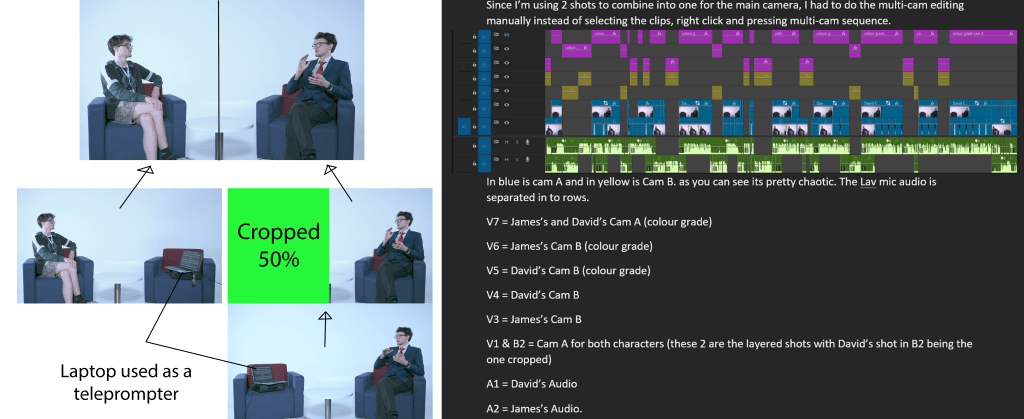
I made this photo to show how the scene was composited. being inspired by some creators on YouTube and social media. I replicated the duplication effect to do this interview. This scene took a day to film from start to finish and almost 3 days to edit due to its complexity. This scene was shot with 3 camera angles to tackle, with one main shot in the middle, one focused on the interviewer and the other on the guest. This is because I had to do the multi-cam sequence manually because of the middle camera shot needing 2 overlaying camera shots to make the clone effect. This meant I had to line up the dialogue, the cuts, and looping the clips of the person listening with the long answers that the scientist was giving to the interviewer. This was to make the interview realistic while it being shot with one person.
I’m really proud of how it turned out in the end, and I’m impressed with my past self for how I edited this scene without using the “create Multi-cam Sequence” feature in Adobe Premiere Pro. This was all done manually, lining up the dialogue, the cuts, and stretching the video to accommodate with the long answers that the scientist was giving to the interviewer.
 Dellow Productions